What’s Actually Changing in Beauty Ads in 2026?
Beauty advertising in 2026 isn’t just evolving — it’s being redefined.
The space is more saturated, more competitive, and more performance-driven than ever. But the biggest shift? Brands are no longer judged only on product or polish — they’re judged on how human, authentic, and culturally aware their marketing feels.
Most ads fade out fast.
But a small percentage continue performing for months, compounding results over time.
That gap isn’t random — it’s strategic.
Authenticity is outperforming automation.
AI-generated content is everywhere, but consumer trust is shifting back toward real, unscripted moments.
TikTok reshaped what “good creative” looks like.
Short-form, demo-first content is now the standard. If your ad doesn’t quickly show value, it doesn’t hold attention. The attention span of humans in 2026 is less than 12 seconds, before viewers are bored and scroll to the next video. In today’s landscape, attention is limited — but trust is what scales.
1. What Actually Wins in Beauty Ads Right Now
At Pennock, we don’t only evaluate ads based on aesthetics — we evaluate them based on performance over time.
Here’s what separates durable creative from short-term wins:
UGC is the foundation of beauty advertising.
36.8% of top ads used UGC-style creative because it builds trust. Human, peer-led storytelling continues to outperform overly produced brand content.
Demo-first creative drives longevity.
38.8% of ads showed the product in action — and nearly half of long-running ads (182+ days) followed this format.
“Show me how it works” consistently outperforms “buy now.”
Animation grabs attention — but doesn’t last.
It appears more in short-term ads (18%) than long-term performers (6%). Strong for testing, weak for scaling.
Most funnels prioritize speed over education.
61.2% of ads drive directly to product pages. Beauty is still optimized for quick conversion — but brands that layer in education often unlock more sustainable growth.
Heavy CTAs = short-term spikes.
Urgency-led messaging (“ends tonight,” “limited time”) tends to fatigue quickly. It can drive clicks, but rarely builds lasting performance.
Creative balance is the real advantage.
Top brands don’t rely on one format. They blend UGC (trust), demo (clarity), and light CTA (conversion) to create assets that work across the funnel.
2. What Creative Formats Are Actually Working
In a scroll-heavy, AI-saturated environment, the question remains…
What creative will actually stop the scroll?
Insights
UGC video is the dominant format.
At 36.8%, UGC outperforms every other format in both engagement and longevity. Real people, real application, shot on mobile — this is what holds attention and sustains performance across the funnel.
Static isn’t dead — it’s strategic.
Single image ads (28.7%) still drive results, especially in retargeting. When paired with strong copy, reviews, or awards, they convert efficiently at the bottom of the funnel.
Polished video underperforms without authenticity.
Professional video (17.2%) only works when it feels native. The more it mimics UGC pacing and storytelling, the better it performs. Overproduced = faster fatigue.
Animation doesn’t hold.
Only 10.3% of top ads used animation — and most were tied to short-term campaigns. It can drive quick engagement, but it rarely sustains.
Carousels play a supporting role.
At just 6.9%, they’re primarily used for mid-funnel education (routines, ingredients), not acquisition or scale.
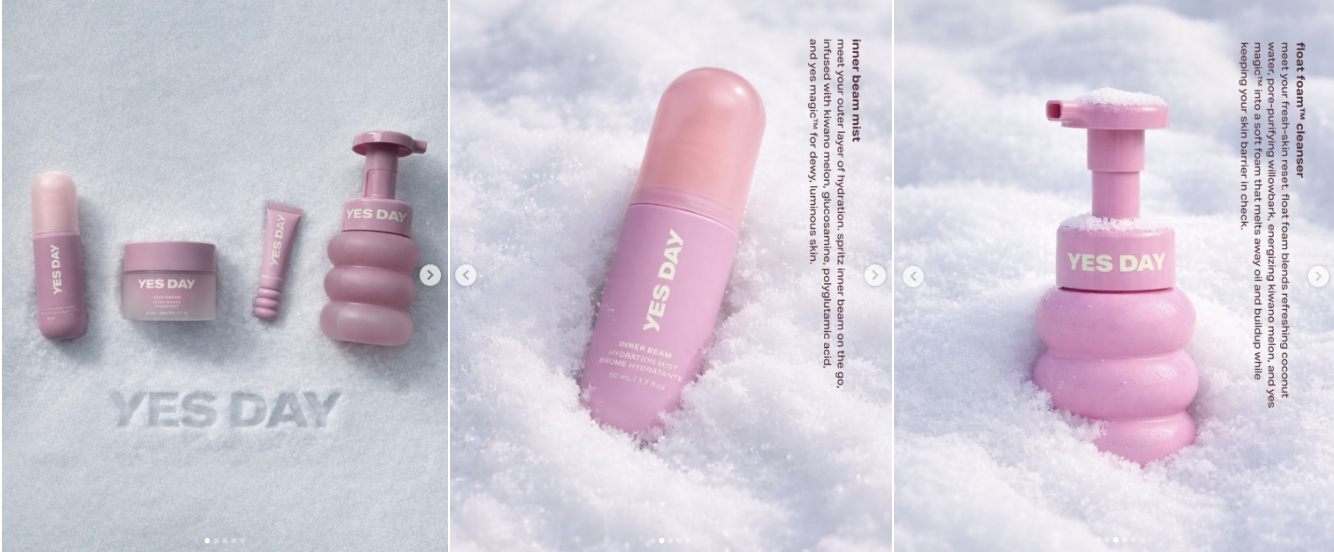
Our Client, Yes Day, Instagram carousel.
Caption: “new year new glow 🤍❄️
cozy glow that keeps your skin hydrated all winter long”
3. The Creative Types That Actually Convert
Format gets you seen — but creative structure is what drives conversion and longevity.
Across 500 top beauty ads, a few clear patterns emerged:
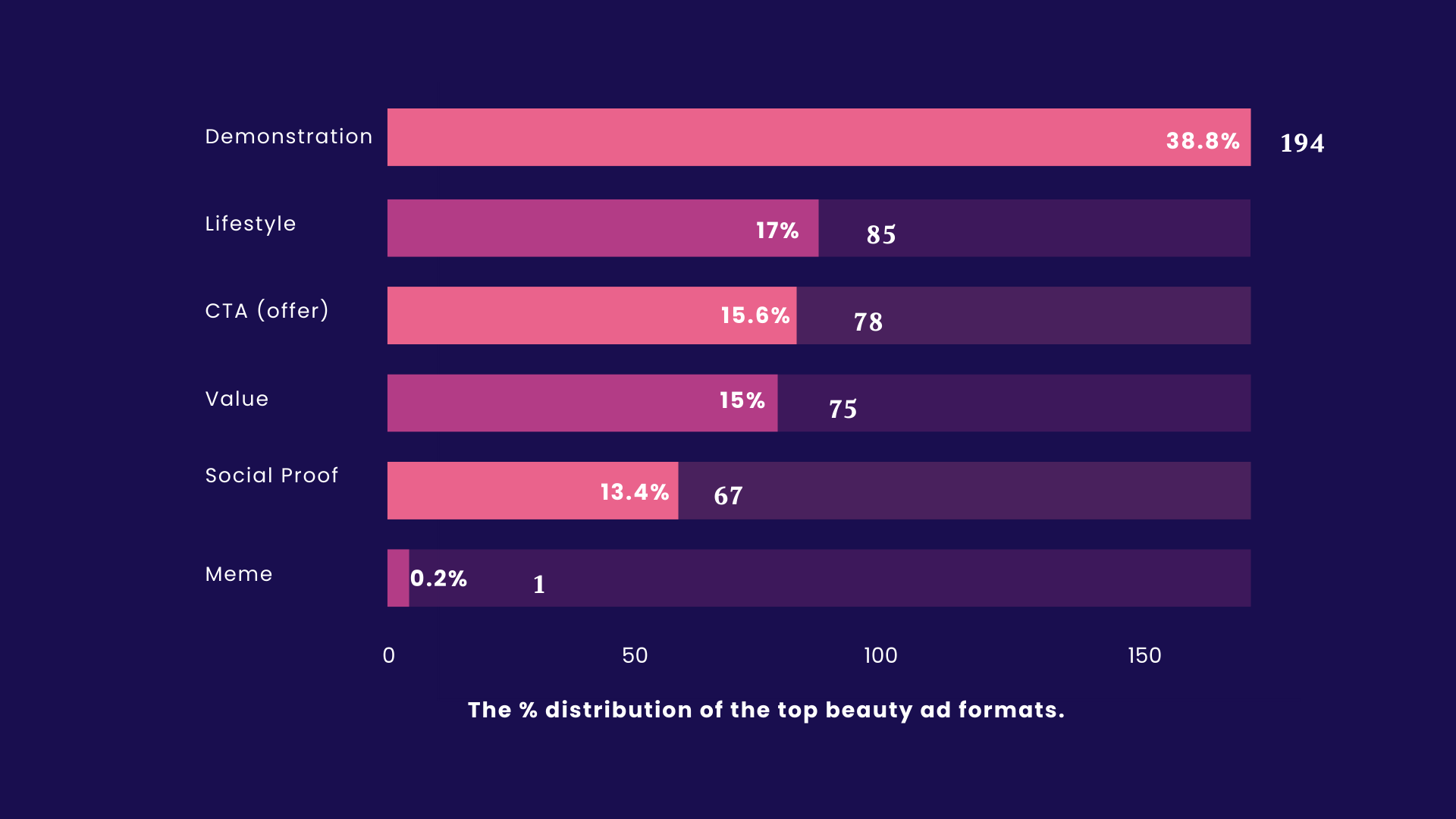
Demonstration wins — by a lot.
Nearly 40% of top ads showed the product in action. Application, blending, real results.
The takeaway is simple: showing how it works consistently outperforms telling.
At 17.1%, lifestyle creative (aesthetic, aspirational moments) plays a key role in perception.
It may not always convert instantly, but it extends ad life and strengthens brand equity — especially when paired with demo.
Our clients, Time Beam and Face Reality, show demonstration videos.
4. Where You Send Traffic Matters
Creative gets the click — but the landing page determines whether it converts.
Here’s what we’re seeing across top-performing beauty ads:
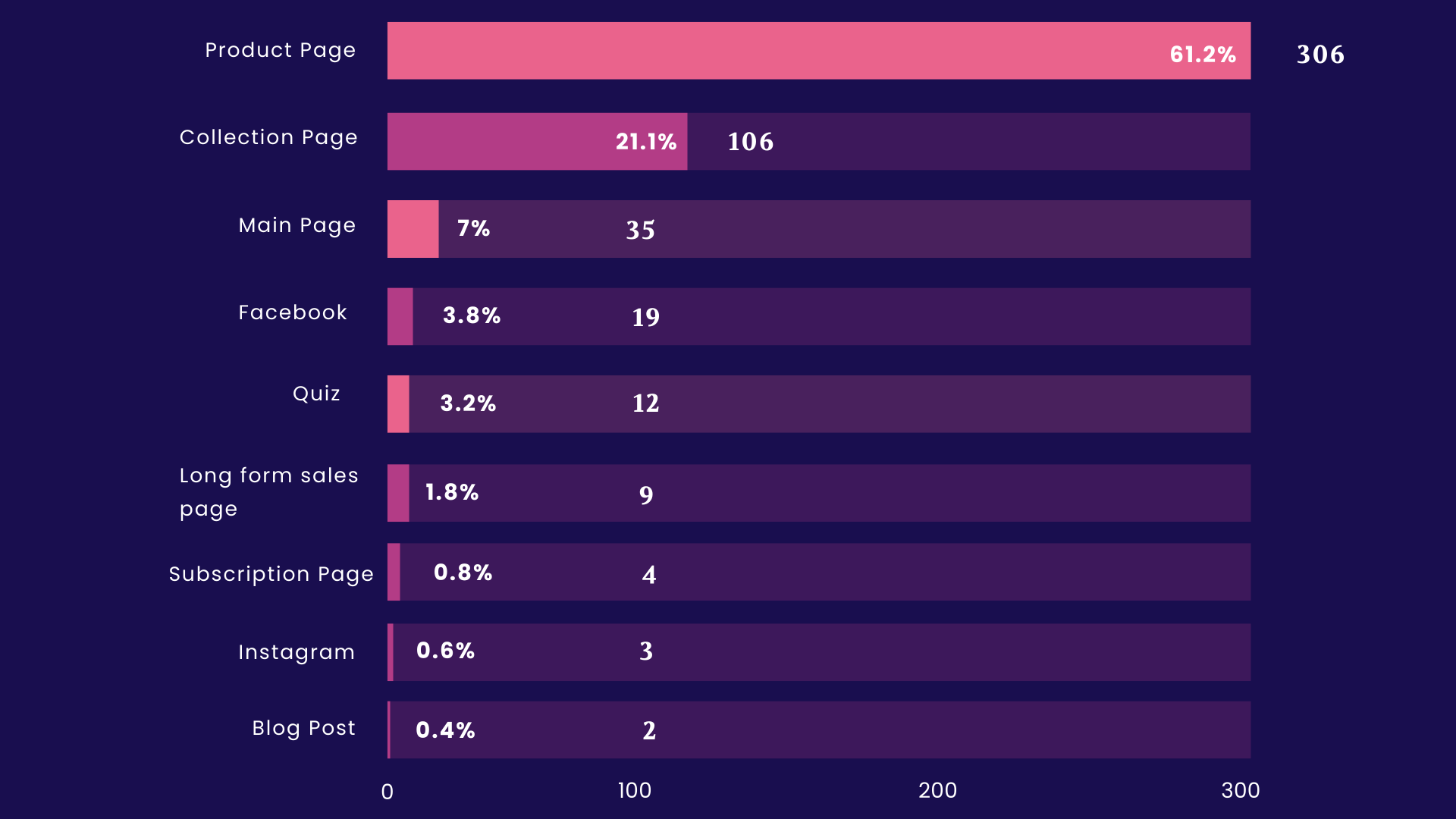
Product pages drive the most conversions.
Over 60% of ads send users directly to a product page. When paired with demo-driven creative, this creates a seamless path: high intent → low friction → faster conversion.
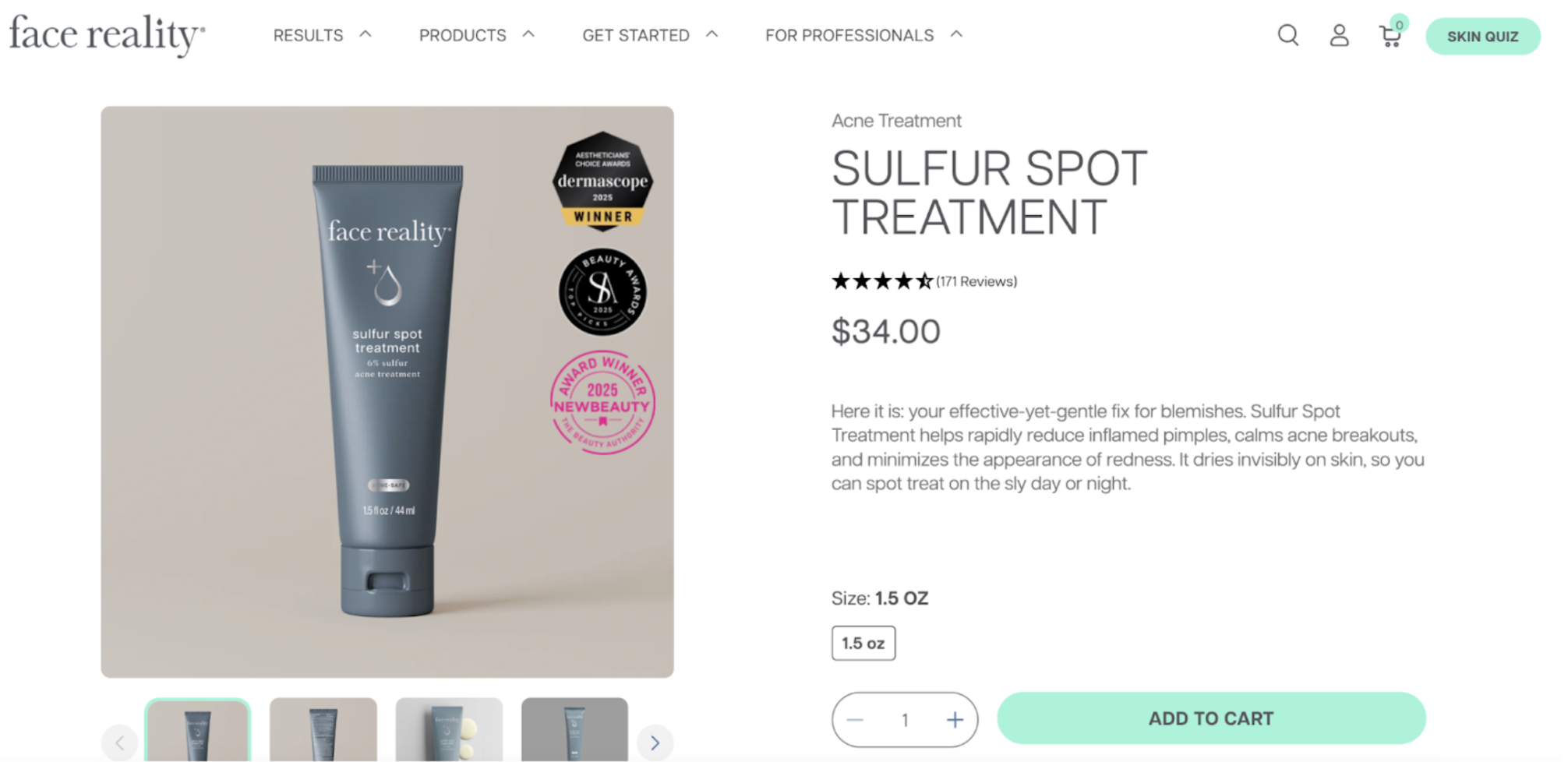
Face Reality’s Product Page Overview
Collection pages support discovery.
At 14.9%, these work best with educational or routine-based creatives, giving new users space to explore before committing. This is very common for companies with multi step skin care routines like our client, Colleen Rothschild.
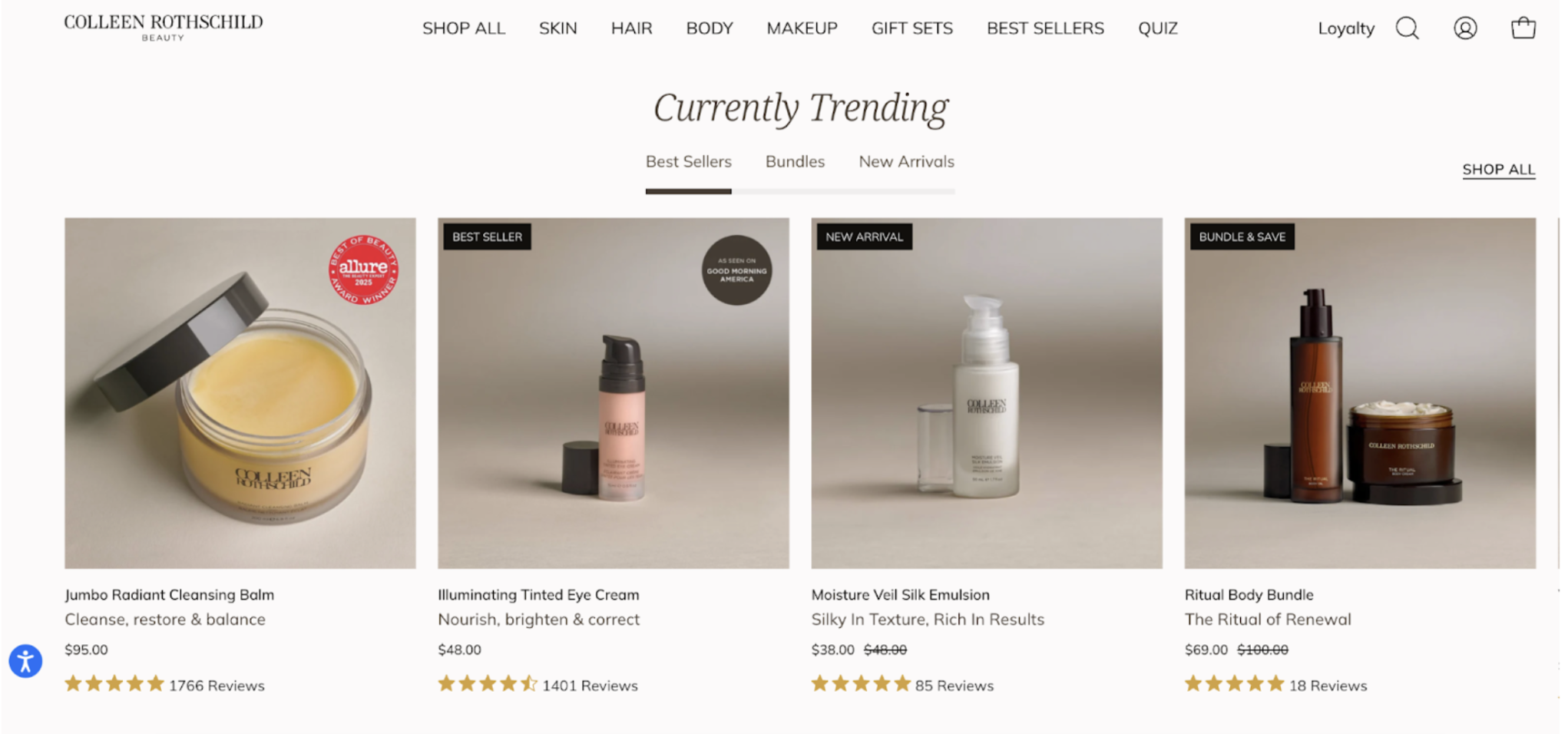
Colleen Rothschild category page overview
Quiz funnels increase value, not volume.
Used by 12.3% of brands, quizzes typically drive higher AOV and conversion rates — especially in personalization-heavy categories like skincare.
Long-form pages build trust for bigger decisions.
Only 7.1% of ads use them, but they’re effective for premium or science-backed products where more education is needed before purchase.
Link-in-bio tools limit conversion.
At 4.5%, they’re mostly used in influencer campaigns — but the extra clicks and lack of focus tend to hurt direct sales.
5. What Actually Works in 2026
After analyzing 500+ top-performing beauty ads, one thing is clear:
The best ads aren’t one-offs — they follow repeatable systems.
This is where strategy turns into execution.
Framework #1: Real Demo. Real Skin. Real Fast.
Best for: Top-of-funnel + scaling
Format: UGC video
Creative Type: Demonstration
Landing Page: Product page
Avg. Ad Duration: ~293 days
How it works:
Start with a real problem → show the product in action → deliver immediate visual proof → close with a light CTA or testimonial.
This framework wins because it combines the three highest-performing levers:
→ Relatability (UGC)
→ Proof (demo)
→ Low-friction conversion (PDP)
Framework #2: Static Value Snapshot
Best for: Bottom-of-funnel + retargeting
Format: Single image
Creative Type: Value/ Offer
Landing Page: Product or bundle page
Avg. Ad Duration: ~178 days
How it works:
Put the product front and center → layer in a clear value prop → reinforce with social proof → close with a direct CTA.
This framework works because it removes friction at the decision stage:
→ Clarity (what it is + why it matters)
→ Credibility (reviews, ratings, claims)
→ Conversion (direct path to purchase)
Framework #3: Clinical Meets Cool
Best for: Science-backed skincare + premium products
Format: Hybrid video or long-form
Creative Type: Educational + social proof
Landing Page: Long-form LP or quiz funnel
Avg. Ad Duration: ~225 days
How it works:
Lead with a clear claim → layer in expert validation → highlight ingredients → show real results → close with a strong CTA.
This framework works because it balances:
→ Credibility (clinical proof, experts)
→ Education (why it works)
→ Trust (real results + reviews)
It’s especially effective when used as a system: short-form cuts for TOFU → deeper landing pages for conversion.
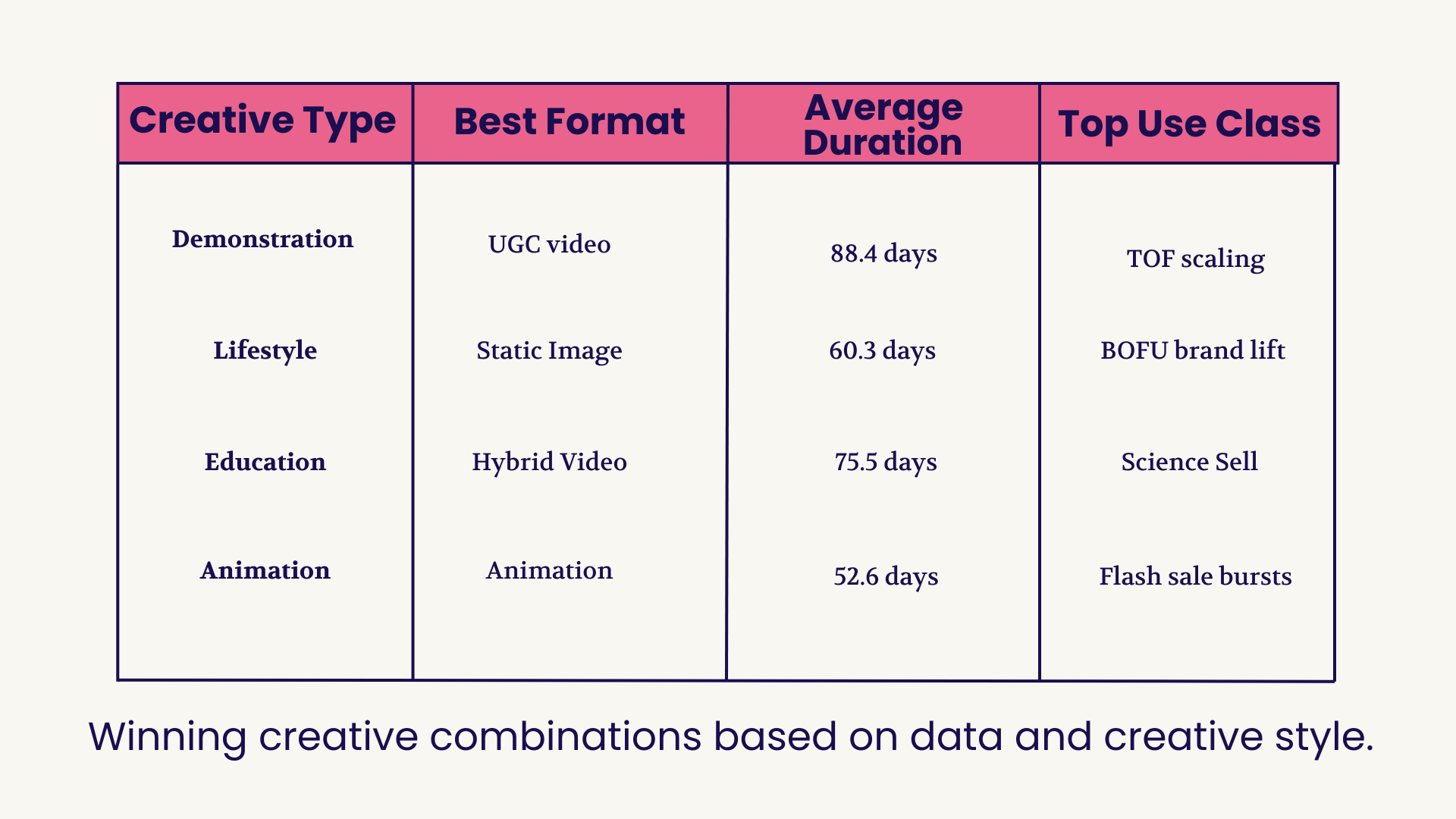
Conclusion:
After analyzing 500+ top-performing beauty ads, one thing is clear:
creative performance isn’t random — it’s predictable.
This isn’t just about trends. It’s about understanding what scales, what fades, and how to build assets that last.
In 2026, winning beauty brands aren’t the ones that look the most polished — they’re the ones that build trust fast, then convert that trust through clarity, proof, and disciplined execution.
The best ads didn’t go viral.
They stayed live.
Because they were built on systems:
→ Earn attention
→ Prove value
→ Remove friction
The takeaway:
If you want sustainable performance, stop chasing new — start building what works.