The Duality of Trust: Navigating AI and Human Expertise in 2026 Beauty Marketing
The beauty industry in 2026 has reached a strategic crossroads. On one side, we have the unprecedented efficiency of generative AI; on the other, a rising consumer demand for radical authenticity and human-verified truth. At Pennock, we’ve identified this shift as the Duality of Trust. To thrive in this new landscape, brands must stop viewing AI and human expertise as opposing forces and instead learn to leverage them as a unified "Science + Style" growth engine.
The Science: Scaling with AI Creative Efficiency
AI has moved from a digital curiosity to a core utility. For beauty brands, the "Science" of AI is about operationalizing speed and personalization at a scale that was previously impossible.
1. Creative Concepts at Scale
Generative AI is transforming the content lab. Major players like L’Oréal are already using AI to generate 3D digital renderings of products, allowing designers to test packaging and campaign concepts in real-time. This technology allows brands to:
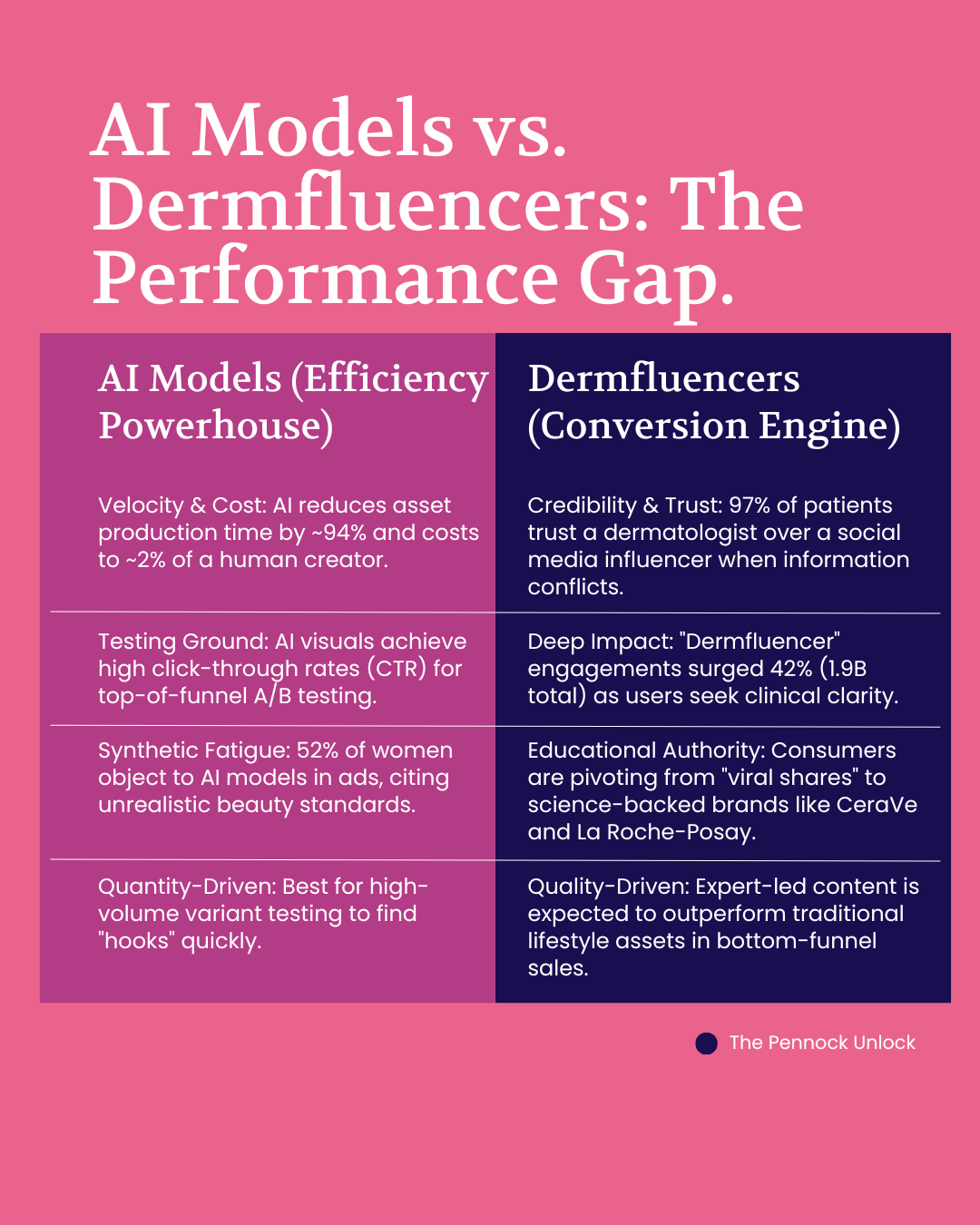
Reduce Production Costs: Some campaigns have seen content creation costs drop by 87% through AI-generated media.
Accelerate Speed-to-Market: Traditional product imagery is being produced twice as fast and at half the cost while maintaining total brand consistency.
Optimize Top-of-Funnel Testing: AI excels at generating high volumes of creative "hooks" for A/B testing, helping brands find high-CTR winners before investing in expensive human-led production.
2. The Rise of AI-Powered Discovery
The mid-funnel is now an AI-driven environment. Today, 51% of shoppers are interested in AI-powered tools to guide their purchases.
Conversational Commerce: Consumers are increasingly turning to AI agents, such as ChatGPT, for detailed "how-to" guides and personalized beauty advice, specifically for complex categories like foundation and contouring.
Hyper-Personalization: AI-guided searches and "Beauty Quizzes" are narrowing consumer choices based on specific skin tones, concerns, and lifestyle factors. For example, Olay’s Skin Advisor uses AI to analyze skin conditions with 90% accuracy, leading to a 200% increase in conversion rates.
The Style: Anchoring Trust in Human Expertise
While the science of AI handles the "how many," the style of human expertise handles the "how real." As AI-generated content peaks, consumer trust in unscripted, human moments is rising again.
1. The "Dermfluencer" Dominance
Consumers are experiencing "treatment burnout" and are tuning out generic influencers in favor of medical authority.
Explosive Engagement: The "Dermfluencer" category—dermatologists who translate clinical science into accessible content—has seen engagements grow by 42%, reaching a total of 1.9 billion.
Unmatched Credibility: In an era of misinformation, 97% of patients trust a board-certified dermatologist over a general social media influencer when advice conflicts.
Proven Conversion: Leading science-backed brands like CeraVe and La Roche-Posay have generated millions in Earned Media Value (EMV) by consistently aligning dermatologist expertise with product education.
2. The AI Transparency Penalty
There is a notable "perception gap" between what advertisers think consumers want and how they actually feel.
Skepticism Toward AI Models: 52% of women object to brands using purely AI-generated models, viewing them as a threat to realistic beauty standards.
The "Negative Halo": Research shows that consumers often perceive disclosed AI-generated ads as "annoying," "boring," or "confusing".
The Memory Gap: EEG studies reveal that even high-quality AI ads elicit weaker brain memory activation compared to traditional human-shot content, potentially making them less effective for long-term brand building.
The Pennock Strategy: Science + Style Hybrid
To win in 2026, brands must deploy a balanced strategy that uses the right tool for the right stage of the journey.
Step 1: Use AI for Mid-Funnel Personalization
Don't just use AI to make ads; use it to make recommendations. Leverage AI to power virtual try-ons—which can increase online conversions by up to 40%—and to personalize email and app notifications based on predicted restock needs.
Step 2: Use Human-Verified Creative for Bottom-Funnel Trust
When it's time to close the sale, lean into human truth. User-Generated Content (UGC) remains the backbone of top-performing beauty ads, with 38.8% of winning assets focusing on real-life product demonstrations rather than polished animations.
Step 3: Anchor with "Dermfluencer" Authority
Replace superficial persuasion with deep education. By partnering with medical experts, you provide the "human-verified" seal of approval that today's skeptical, science-literate consumer demands.
The Bottom Line:
AI is your sidekick for scale, but human expertise is your hero for trust. By combining the logistical "Science" of AI with the credible "Style" of human experts, beauty brands can build a resilient marketing system that converts today while building equity for tomorrow.