Meta Creative Development Has Changed: Andromeda Is the Catalyst
For years, performance marketers followed a predictable creative testing formula: take one product image or video, layer on multiple hooks, swap headlines, test a few offers, and let Meta determine the winner.
With the rollout of Meta’s Andromeda system, that approach is no longer enough. Today, Meta rewards creative diversity and persona-driven storytelling, not surface-level copy variations.
This shift is especially important for brands in beauty, skincare, and hair care, where context, emotion, and lifestyle matter as much as the product itself.
What Is Meta Andromeda?
Andromeda is Meta’s next-generation creative evaluation and delivery system. Rather than treating each ad as a standalone unit, Andromeda looks at patterns across creatives including visuals, formats, scenarios, and personas to determine how ads should be delivered and scaled.
In simple terms:
Meta is no longer optimizing for the best-performing headline — it’s optimizing for the most relevant creative experience for each user.
This has major implications for how brands should approach creative testing.
The Old Way of Creative Development
Historically, creative testing on Meta looked like this:
One hero product image or video
Multiple text overlays or hooks
Slight offer variations (discounts, free trial, bundles)
Minimal changes to visuals
Like this:
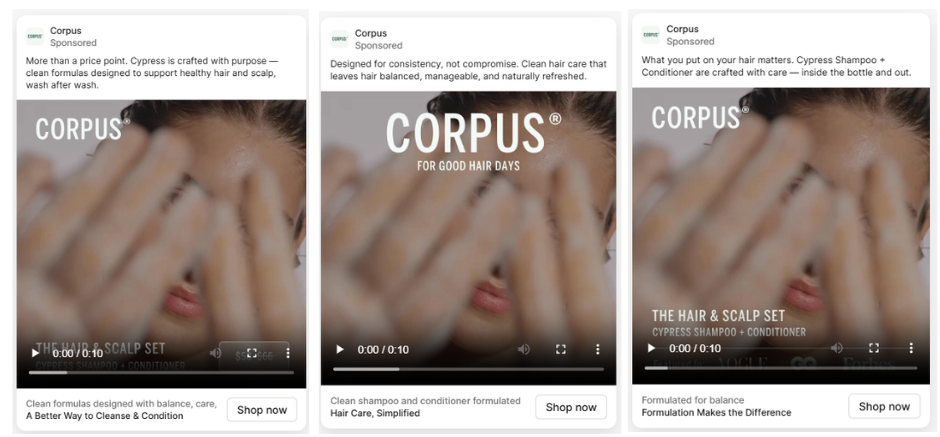
These ads were designed to appeal to a broad, generalized persona, with copy doing most of the differentiation. Visually, everything looked nearly identical.
This worked in an environment where Meta relied more heavily on copy signals and targeting inputs to determine delivery.
Why the Old Way Is Less Effective Today
Under Andromeda, ads that look and feel the same are often interpreted as interchangeable. When creative inputs lack differentiation, Meta has fewer signals to determine who should see which ad.
As a result:
Similar creatives compete with each other
Reach expansion is limited
Performance plateaus more quickly
Creative fatigue sets in faster
Small copy changes no longer create meaningful testing insights.
The New Way: Persona-Led Creative Systems
Modern Meta creative development starts with who the ad is for, not just what the ad says.
Instead of testing copy variations on the same asset, brands now build distinct creative concepts around different personas, use cases, or moments.
For a skincare or beauty brand, this might include:
A social, younger consumer focused on glow and confidence
A busy consumer prioritizing speed and simplicity
A mature consumer focused on long-term skin health
An active consumer focused on recovery and protection
Each persona is expressed through:
Different models or talent
Unique environments and scenarios
Distinct emotional tones
Messaging that supports the visual story
The product stays the same but the context changes.
Why Andromeda Rewards This Approach
Persona-led creative gives Meta clearer signals about:
Who the ad is relevant for
When it should be shown
What user intent it matches
Instead of forcing Meta to infer meaning from similar-looking ads, brands provide clear creative cues that Andromeda can act on.
This allows multiple creatives to scale simultaneously without competing against each other.
Why This Matters for Beauty Brands
Beauty consumers are not a monolith. They engage with products based on:
Lifestyle
Emotional needs
Time constraints
Personal goals
Creative that reflects real-life moments performs better than generic product messaging. Under Andromeda, brands that show how a product fits into different lives, not just what it does, are better positioned to scale.
The brands winning on Meta today aren’t louder or more promotional.
They’re more specific.
They don’t ask:
“What’s our best hook?”
They ask:
“Who is this ad for — and what do they care about right now?”
Best Practices for Creative Development on Meta Today
To align with Andromeda, brands should:
Prioritize concept diversity over copy volume
Design creatives around personas and moments
Use visuals to communicate intent
Test more ideas, not more text
Build creative systems, not one-off ads
The goal is not more ads, it’s clearer, more intentional creative.

Frequently Asked Questions on Andromeda and Creative Testing
Does Meta targeting still matter?
Yes, but far less than before. Targeting now provides guardrails, while creative determines delivery.
What is the biggest mistake brands make post-Andromeda?
Running multiple ads that look identical and expecting Meta to “figure it out.”
Is copy still important with Meta Andromeda?
Absolutely, but copy supports the creative concept. It no longer carries performance on its own.
How does creative diversity impact Advantage+ campaigns?
Advantage+ amplifies creative differences. Strong creative systems scale faster; weak ones stall sooner.
How different do creatives need to be for Andromeda to recognize them?
Creatives should differ visually and contextually — not just in text. Changes in setting, talent, scenario, and emotional tone are stronger signals than headline or offer swaps.
Can the same product be marketed to multiple personas at once with Andromeda?
Yes — and Andromeda is designed to support this. The same product can be positioned for different lifestyles or use cases, as long as each creative clearly communicates a unique perspective.
Does Andromeda favor UGC or polished creative?
Andromeda does not favor a specific style. It favors clarity and relevance. Both UGC and polished creative can perform well if they clearly communicate who the ad is for and why it matters.
Final Takeaway
Andromeda didn’t eliminate creative testing, it evolved it.
The brands seeing the strongest results on Meta today are the ones moving beyond copy swaps and toward persona-driven creative development.
In a post-Andromeda world, creative isn’t just what users see.
It’s how Meta decides who sees it.